Most Mandeville sellers brace for the home inspection. They worry about the roof, the water heater, maybe a soft spot on the deck. Few think twice about the one-page pest report that shows up alongside it, and that's the document that actually reopens negotiations more often than anything else.
In Louisiana, a Wood Destroying Insect report is a separate, state-regulated inspection from the general home inspection. It's produced by a licensed pest control operator, not the home inspector, and it's required by most lenders and purchase agreements before closing can happen. The report itself is inexpensive, typically running $100 to $200 for a real estate transaction. What it finds is the expensive part, and in a market with Mandeville's housing stock and climate, what it finds is rarely nothing.
A report your home inspector isn't qualified to write
A WDI report, sometimes called a WDO or WDIR depending on who you ask, documents visible evidence of termites, carpenter ants, powder post beetles, and similar pests, along with any conditions that make future infestation more likely. It's a distinct form, filed under Louisiana Department of Agriculture and Forestry rules, and it carries legal weight that a general home inspection report doesn't. VA and FHA loans in particular lean on it heavily, and most conventional lenders in the region ask for one as a matter of course.
The reason this catches sellers off guard isn't the paperwork. It's the timing. The WDI inspection usually happens during the same window as the general inspection, but the finding it produces, active or previous termite activity, tends to trigger a different kind of response from buyers than a cracked tile or a leaky faucet. A leaky faucet gets a repair credit. Termite activity gets a treatment requirement, a delay while a licensed operator schedules and completes the work, and sometimes a full clearance letter before the closing date can be confirmed.
Why this is a Northshore problem, not a generic one
Formosan subterranean termites are widely regarded as the most destructive structural pest active in Louisiana, and St. Tammany Parish sits well inside their range. Unlike the native subterranean termites that swarm during the day, Formosan termites fly at dusk, prefer warm, humid, windless evenings, and can produce colonies large enough to cause serious damage in a short window. In May 2026, a swarm event was significant enough that the St. Tammany Parish Sheriff's Office captured video of a deputy's car surrounded by termites, and local news coverage quoted Kevin Dawson of Pied Piper Pest Control describing how the pests find their way into homes through vents, cracks, and windows once outdoor lights draw them in.
That swarm season runs roughly from Mother's Day through late June most years. It doesn't line up with when most sellers schedule inspections, which means a home can look completely clean in March and still carry evidence of an active colony a WDI inspector picks up in August, simply because the swarm happened and the report is documenting what's visible now, not what was visible six months ago.
Old Mandeville's homes were built for a different problem entirely
The parts of Mandeville that carry the most character, Old Mandeville along Lakeshore Drive, the Lafitte Street corridor, Lewisburg across the Bayou Castine bridge, hold homes dating to the 1830s and 1840s along the lakefront, with more built in the early 1900s as the town's resort era gave way to year-round living. These homes were built to catch lake breezes and survive Louisiana heat, not to resist a termite species that didn't arrive in the state until after World War II.
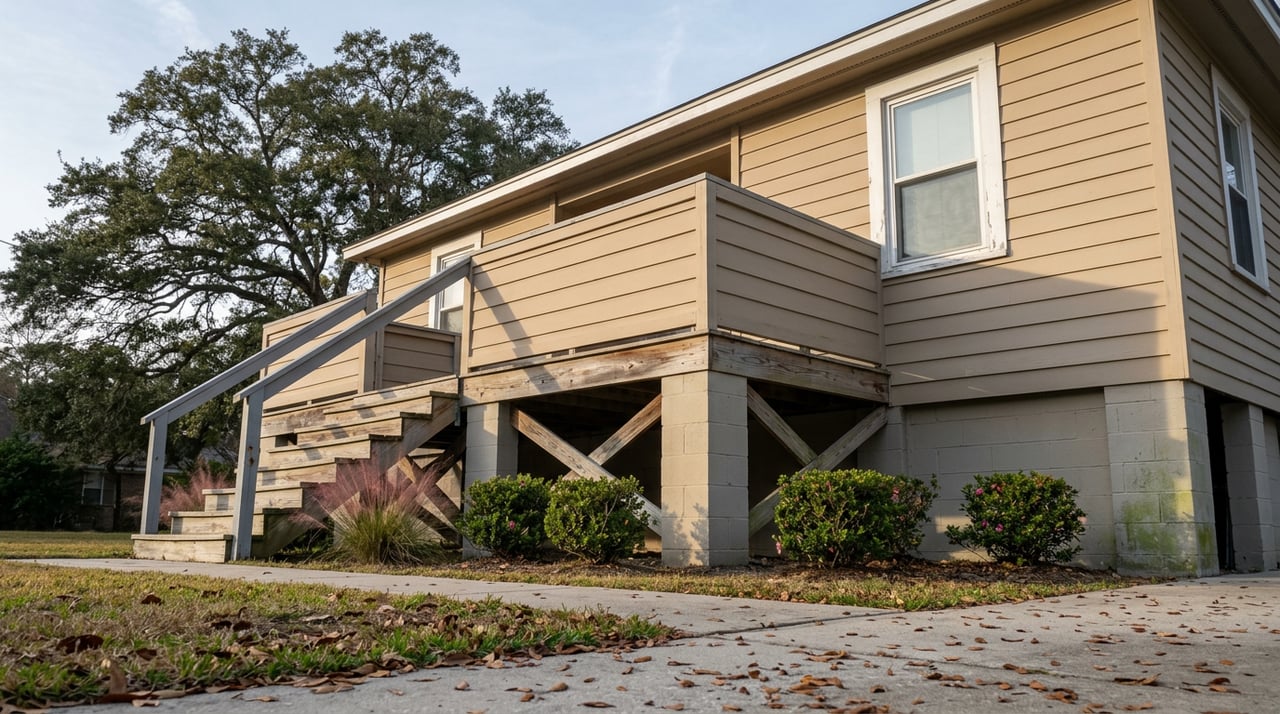
Many of them also sit on pier and beam foundations rather than slabs, a construction method common in Southern homes built before the 1960s. Pier and beam creates a crawl space, which is good for accessibility but also creates exactly the kind of wood-to-ground contact and hidden moisture conditions that give termites an easy path in. After Hurricane Katrina, roughly 70 percent of structures in Mandeville's historic district were elevated to meet new flood requirements, according to reporting from the Preservation Resource Center, which means a large share of these older homes now have raised foundations inspected and maintained by pest professionals who know the difference between a period-appropriate cedar pier and one that's been quietly rotting for two decades.
None of this means an older Mandeville home is a liability. It means the WDI inspector is working with a more complicated crawl space than they'd find in a newer subdivision off Highway 22, and complicated crawl spaces produce more findings, not fewer.
What a finding actually does to your closing timeline
Here's where the report earns its reputation. A general home inspection finding usually resolves with a credit, a repair, or a walk-away. A WDI finding resolves differently, because most purchase agreements and every VA or FHA loan require treatment and a clearance before the deal can close, not just a price adjustment.
| Inspection type | Typical resolution |
|---|---|
| General home inspection item (roof, plumbing, appliance) | Repair, credit, or negotiated price adjustment |
| WDI report, no findings | No action needed, closing proceeds |
| WDI report, active infestation or conducive conditions | Treatment scheduled, retreatment or clearance letter required before closing |
That middle step, scheduling treatment and waiting on a clearance letter, is what adds days to a closing that was otherwise ready to go. It's rarely a deal killer. It is, reliably, a deal delayer, and delays cost sellers leverage.
What sellers can do before a buyer's inspector ever shows up
The sellers who avoid the mid-contract scramble are the ones who treat the WDI report as something to get ahead of, not react to. A few things make a real difference:
- Schedule a pre-listing WDI inspection through a Louisiana-licensed operator before you list, not after you're under contract. Several Northshore-based companies, including Pied Piper Pest Control, Billiot Pest Control, J&J Exterminating, and Brans Pest Control, handle these inspections regularly in the Mandeville area.
- If your home has a crawl space, ask your inspector specifically about wood-to-ground contact and mulch depth against the foundation. The LSU AgCenter recommends keeping mulch 8 to 12 inches from the foundation, which is a simple fix if it's flagged early instead of during a buyer's contract window.
- If you're listing during swarm season, from roughly Mother's Day through late June, turn off exterior lights at night where practical. Swarmers are drawn to light, and a swarm event during a showing period is not the impression most sellers want to make.
- Keep any prior treatment records or termite bond documentation. A history of consistent treatment reassures both buyers and their lenders far more than a spotless-looking report with no paper trail behind it.
None of this guarantees a clean report. It does mean that if something turns up, you're finding out on your own schedule instead of the buyer's, with time to treat it quietly rather than renegotiate it publicly.
A few questions sellers ask before listing
Is a WDI report legally required to sell a home in Louisiana? It's not required by state law for every sale, but it's required by most lenders, including all VA and FHA-backed loans, and it's a standard part of most Louisiana purchase agreements, which makes it effectively unavoidable in most transactions.
How long is a WDI report valid? Most lenders want the report dated close to closing, generally within 30 to 90 days depending on the loan type, since it documents conditions visible on the day of inspection, not a permanent state of the home.
What happens if termites are found after I already have a buyer under contract? Treatment gets scheduled with a licensed operator, and most contracts allow the closing date to shift to accommodate the clearance letter. It adds time but rarely derails a deal outright, especially if the seller responds quickly rather than disputing the finding.
Selling an older Mandeville home, especially one with the character of Old Mandeville or Lewisburg, means selling something that's survived a century of lake weather and at least one determined invasive species. That's a strength worth marketing. It's also a reason to know exactly what the WDI report will say before a buyer's financing depends on the answer.
If you're thinking about listing in Mandeville and want a read on what your specific property, foundation type, and neighborhood mean for pricing and timeline, Team CeejaySells works this market every day. Get Your Free Home Valuation and let's talk through what your home's history means for your sale before a buyer's inspector tells you first.