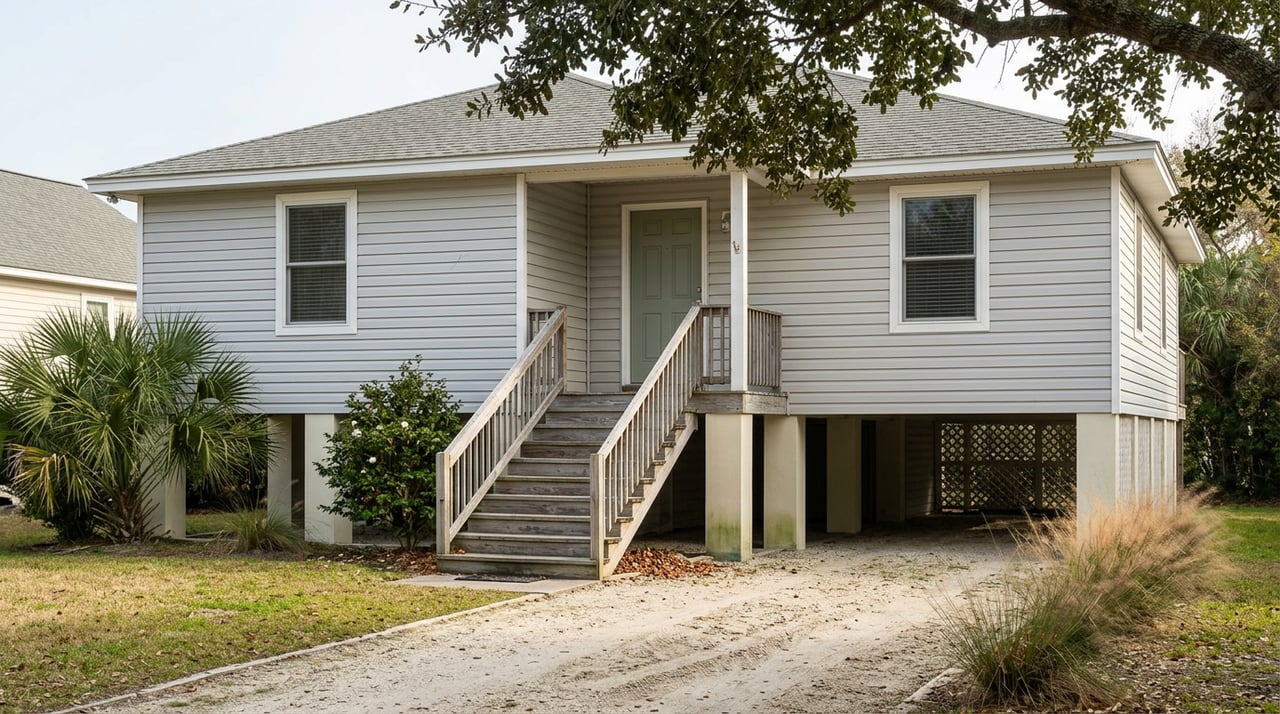
What does a $350,000 house on the Mississippi Gulf Coast actually cost to hold onto, and will you even be allowed to rent it out the way you're picturing? Two buyers can close on the same weekend at the same price and land on opposite answers to both questions, and the gap has almost nothing to do with the number on the listing.
That's the part the median price hides. A coastal home's real cost of ownership is set less by its square footage than by which side of a county line it sits on, how close it is to the water, and what a specific city's zoning code says about short-term rentals. If you're comparing Bay St. Louis, Gulfport, Biloxi, and Ocean Springs as places to put money into a second home or a rental property, the sale price is the easy part. The insurance stack and the zoning code are where the real math lives.
The Insurance Stack Nobody Prices In From the Start
Standard homeowners insurance sold in coastal Mississippi does not cover wind and hail, and it does not cover flood. That means a buyer on the coast is typically assembling three separate policies just to insure one house:
- A homeowners policy that excludes wind and hail damage
- A wind and hail policy, usually written through the Mississippi Windstorm Underwriting Association, the state's insurer of last resort for the six coastal counties of Hancock, Harrison, Jackson, Pearl River, Stone, and George
- A flood policy through the National Flood Insurance Program, since no standard policy pays out for storm surge or rising water
Stack all three together on a coastal property and the combined bill can run past $12,000 a year. That's not a worst-case number. It's a routine one for homes close to the water in a Zone V or VE flood designation, where FEMA's Risk Rating 2.0 system prices flood coverage between roughly $2,000 and $5,000 annually on top of the homeowners and wind premiums.
This is the friction that catches out-of-area buyers off guard most often. A retiree comparing a coastal Mississippi cottage to a similarly priced inland property somewhere else isn't just comparing two houses. They're comparing one policy to three, and the third one doesn't show up until the mortgage lender requires it a few weeks before closing.
Why the Wind Coverage Just Got More Expensive
The wind portion of that stack moved in January. MWUA rates rose 16 percent effective January 1, 2026, a jump tied directly to the state pulling back the subsidies that had kept coastal wind coverage artificially cheap. Mississippi has directed more than $400 million since 2005 toward propping up those rates through reinsurance purchases, and Insurance Commissioner Mike Chaney has been blunt that the approach isn't sustainable long term.
The practical read for a buyer: don't budget for last year's wind premium. Ask for the seller's current MWUA declarations page, not a policy quote from before January, and confirm the number with an agent licensed to write MWUA coverage before you get attached to a monthly payment estimate.
The One Lever Buyers Actually Have
There is a real offset to all of this, and it's new enough that a lot of buyers haven't heard of it yet. On April 2, 2026, both chambers of the Mississippi Legislature unanimously passed Senate Bill 2409, creating the Strengthen Mississippi Homes Program inside the Mississippi Department of Insurance. The program took effect July 1, 2026 and funds grants of up to $10,000 per home, awarded by lottery, to retrofit a roof to the IBHS FORTIFIED standard. Funding comes from the insurance industry itself, at roughly $16 million a year.
The eligibility rules are specific: single-family, owner-occupied homes only. Condos and manufactured homes don't qualify. That matters for the second-home buyer looking at a beach condo in Biloxi, since this particular lever isn't available to them, but it's directly relevant to anyone buying a single-family coastal cottage as a primary or eventual retirement residence. State law already requires insurers to offer premium discounts for FORTIFIED construction, so a buyer who retrofits under this program isn't just protecting the roof. They're setting up a lower wind premium on the next renewal.
The takeaway isn't that this grant solves the insurance math. It's that the insurance math on the coast is partly a design problem, and Mississippi just funded the first real statewide attempt to fix it at the roof level rather than the premium level.
The Rental Income You're Counting On May Not Be Legal Yet
Here's the second half of the hidden math, and it's the one that trips up investors specifically. A lot of Gulf Coast purchase decisions assume the property can generate short-term rental income to offset the insurance stack above. That assumption depends entirely on which city the house sits in, and the rules are not close to uniform.
| City | What's actually required | The catch for buyers |
|---|---|---|
| Gulfport | A short-term rental permit through the Department of Urban Development, plus liability insurance of at least $500,000 per occurrence | Gulfport's zoning code only allows uses specifically listed for each district. If short-term rental isn't a listed use in that zone, it's prohibited by default, not something you can apply your way around |
| Biloxi | A Conditional Use Permit, including inspections, fees, and renewals, on top of a city business license | Beachfront properties face additional safety and occupancy standards layered on top of the base permit process |
| Ocean Springs | City registration before operating, plus state tax registration | The registration requirement is recent, part of a broader tightening as the city's popularity with remote workers and arts travelers has driven up rental demand |
| Bay St. Louis | Active permit renewals for 2026 through the Planning and Zoning Department | The city is simultaneously drafting a new 2045 Zoning Ordinance, presented by Orion Planning and Design in January 2026 and currently in public comment, which could reshape short-term rental rules on the peninsula before your first booking season |
The common thread is that none of these cities treat short-term rental as a right that comes with the deed. It's a permitted use, a conditional use, or in Gulfport's case, often not a use at all unless the property sits in one of the specific districts where it's listed. Verifying zoning before you write an offer isn't a formality here. It's the difference between a property that pencils out and one that doesn't.
What This Means If You're Comparing Cities
Put the two halves together and the pattern becomes clear. A house in a high-wind, high-flood-risk zone in a city with restrictive short-term rental zoning carries the worst of both worlds: the highest insurance stack and the least reliable path to rental income offsetting it. A house set back from the water, in a district where short-term rental is an allowed use, or built to FORTIFIED standard and eligible for a lower wind premium, can carry a meaningfully lower true cost of ownership even at a higher sale price.
That's the calculation the listing price alone will never show you. Before comparing two coastal properties on price per square foot, a buyer should be asking for the seller's current MWUA and flood declarations, confirming the property's zoning district and whether short-term rental is a listed or conditional use there, and checking whether the roof already meets FORTIFIED standard or would qualify for the grant program now that it has taken effect.
If you're selling a home elsewhere on the Northshore to fund a move to the coast, that comparison starts with knowing what your current property is worth. The team at CeejaySells works both sides of that decision, from pricing a Northshore sale to walking a buyer through what a specific coastal address will actually cost to insure and whether it can legally do the job you're buying it to do. Reach out for a free home valuation before you start comparing coastal listings, so you know exactly what you're working with on both ends of the move.
A Few Questions Worth Asking Before You Offer
Does homeowners insurance cover storm surge damage? No. Storm surge is flood damage, and no standard homeowners or wind policy covers it. Only a separate NFIP or private flood policy responds to storm surge, which is why it's treated as a third, non-negotiable line item on the coast rather than an optional add-on.
Can I count on short-term rental income before I close? Not safely. Confirm the property's zoning district and whether short-term rental is currently an allowed or conditional use in that specific district, in that specific city, before you build a rental projection into your offer. Rules differ block by block in some of these cities, not just city by city.
Is the Strengthen Mississippi Homes grant available now? The program took effect July 1, 2026, funding FORTIFIED roof retrofit grants up to $10,000 for eligible owner-occupied single-family homes, awarded through a lottery. Condos and manufactured homes are excluded. Ask your insurance agent about current application status and timing, since a lottery-based rollout can take time to open to new applicants after an effective date.